Friday, 6 February 2015

What is a server ? What does a server do ? How many type of servers are there ?

What does a server do?

A server is a computer that serves information to other computers. These computers, called clients, can connect to a server through either a local area network (LAN) or a wide area network (WAN), such as the Internet.

There are a number of different types of servers, including Web servers, mail servers, and file servers. A web server serves Web pages to computers that connect to it. It also can parse scripting languages such as PHP, ASP, and JSP. 

A mail server stores users' e-mail accounts and sends and receives e-mail messages. For example, when you send an e-mail to a friend, the message is sent by a mail server, using the SMTP protocol. 

A file server is a computer that stores files that can be accessed by other computers. File servers are often used within local networks and typically require a password or some kind of authentication to connect to it.

These are a few examples of some common servers, but several other types of servers exist. Just about any computer can be used as a server if the necessary server software is installed on it. While servers typically don't need a lot of processing power, lots of RAM and fast hard drives are helpful for dealing with heavy traffic to and from the server.

A server is a system (software and suitable computer hardware) that responds to requests across a computer network to provide, or help to provide, a network service. Servers can be run on a dedicated computer, which is also often referred to as "the server", but many networked computers are capable of hosting servers. In many cases, a computer can provide several services and have several servers running.

Servers operate within a client-server architecture. Servers are computer programs running to serve the requests of other programs, the clients. Thus, the server performs some tasks on behalf of clients. The clients typically connect to the server through the network but may run on the same computer. In the context of Internet Protocol (IP) networking, a server is a program that operates as a socket listener.

Servers often provide essential services across a network, either to private users inside a large organization or to public users via the Internet. Typical computing servers are database server, file server, mail server, print server, web server, gaming server, and application server.

A server is a computer that provides data to other computers. It may serve data to systems on a local area network (LAN) or a wide area network (WAN) over the Internet.

Many types of servers exist, including web servers, mail servers, and file servers. Each type runs software specific to the purpose of the server. For example, a Web server may run Apache HTTP Server or Microsoft IIS, which both provide access to websites over the Internet.

A mail server may run a program like Exim or iMail, which provides SMTP services for sending and receiving email. A file server might use Samba or the operating system's built-in file sharing services to share files over a network.

While server software is specific to the type of server, the hardware is not as important. In fact, a regular desktop computers can be turned into a server by adding the appropriate software. For example, a computer connected to a home network can be designated as a file server, print server, or both.

While any computer can be configured as a server, most large businesses use rack-mountable hardware designed specifically for server functionality. These systems, often 1U in size, take up minimal space and often have useful features such as LED status lights and hot-swappable hard drive bays.

Multiple rack-mountable servers can be placed in a single rack and often share the same monitor and input devices. Most servers are accessed remotely using remote access software, so input devices are often not even necessary.

While servers can run on different types of computers, it is important that the hardware is sufficient to support the demands of the server. For instance, a web server that runs lots of web scripts in real-time should have a fast processor and enough RAM to handle the "load" without slowing down. A file server should have one or more fast hard drives or SSDs that can read and write data quickly. 

Regardless of the type of server, a fast network connection is critical, since all data flows through that connection.

CLOUD SERVER HOSTING

Cloud server hosting is a type of hosting in which hosting services are made available to customers on demand via the Internet.  Rather than being provided by a single server or virtual server, cloud server hosting services are provided by multiple connected servers that comprise a cloud. Cloud server hosting is also sometimes referred to as cluster server hosting or server on-demand hosting.

Cloud server hosting offers the advantages of increased accessibility and reliability, seamless scalability and potential cost savings, as customers are freed from having to invest in on-premises servers and hardware, and they pay only for the resources they consume.  On the other hand, security and lack of access and full control are potential concerns with cloud server hosting


WEB SERVER

Web servers are computers that deliver (serves up) Web pages. Every Web server has an IP address and possibly a domain name. For example, if you enter the URL 

http://www.pcwebopedia.com/index.html in your browser, this sends a request to the Web server whose domain name is pcwebopedia.com. The server then fetches the page named index.html and sends it to your browser.

Any computer can be turned into a Web server by installing server software and connecting the machine to the Internet. There are many Web server software applications, including public domain software from NCSA and Apache, and commercial packages from Microsoft, Netscape and others


PROXY SERVER

A server that sits between a client application, such as a Web browser, and a real server. It intercepts all requests to the real server to see if it can fulfill the requests itself. If not, it forwards the request to the real server.

Proxy servers have two main purposes:

Improve Performance: Proxy servers can dramatically improve performance for groups of users. This is because it saves the results of all requests for a certain amount of time. Consider the case where both user X and user Y access the World Wide Web through a proxy server. First user X requests a certain Web page, which we'll call Page 1. 

Sometime later, user Y requests the same page. Instead of forwarding the request to the Web server where Page 1 resides, which can be a time-consuming operation, the proxy server simply returns the Page 1 that it already fetched for user X. Since the proxy server is often on the same network as the user, this is a much faster operation. 

Real proxy servers support hundreds or thousands of users. The major online services such as America Online, MSN and Yahoo, for example, employ an array of proxy servers.

Filter Requests: Proxy servers can also be used to filter requests. For example, a company might use a proxy server to prevent its employees from accessing a specific set of Web sites.


DEDICATED SERVER

A dedicated server is a single computer in a network reserved for serving the needs of the network. For example, some networks require that one computer be set aside to manage communications between all the other computers. 

A dedicated server could also be a computer that manages printer resources. Note, however, that not all servers are dedicated. In some networks, it is possible for a computer to act as a server and perform other functions as well.

In the Web hosting business, a dedicated server is typically a rented service. The user rents the server, software and an Internet connection from the Web host.


APPLICATION SERVER

Also called an appserver, an application server is a program that handles all application operations between users and an organization's backend business applications or databases.

An application server is typically used for complex transaction-based applications. To support high-end needs, an application server has to have built-in redundancy, monitor for high-availability, high-performance distributed application services and support for complex database access.


What are Proxy Servers?
The other day, I was searching for some proxy sites in order to get access to facebook which is blocked in my institute. After some search I did get a site but then arose a question in my mind: - What are proxy servers? 

Proxy servers, just like simple web servers, complete the requests made by clients. But the difference is that proxy servers don't have the resource that clients request for. A proxy server just connects clients to the main web server and acts as a middleman/ intermediary. It is like you trying to talk to your friend through a third person. Then the next question that came to my mind was: - Why do we need a proxy server then, can't we directly contact web servers to gain the required information ? Yes, we can but there are situations where using a proxy server is beneficial for a user as well as for organizations


Proxy Server Concept

Uses of Proxy Servers

Now that you have some idea about what a proxy server is, you may think that we don't need a proxy server if we can access some resource or file directly from a web server. But there are some inherit advantages of using a proxy server for a general user as well as organisations.

Due to various reasons, organisations and ISPs block access to various sites. This content filtering is made possible by proxy servers. So depending on the content access policies of the organisation, the network administrator can configure the settings of proxy servers.

Proxy Servers also help in improving the performance by addressing client requests faster. This is possible by use of cache. Consider that you access facebook often using proxy site. Then a friend of yours, on the same network, also tries to connect to facebook through the proxy site. Facebook homepage will now be saved in the proxy server’s cache rather than retrieving from remote server again and your friend will be able to access it faster.

Proxy Server helps in keeping the client's IP address anonymous, thus ensuring better security.
Although they help organisations in blocking sites and filtering content but at the same time, some proxies allow user to access blocked sites. Such proxies help the user get through various firewalls and controlling softwares which are installed to regulate access.

Proxies can be used to log internet usage within an office or by a particular user.
Proxy server can be used as firewall to scan outbound and inbound flow of data. Thus they also nullify chances of hacking.

I hope now you know the advantages of proxy servers. But a word of caution, proxy servers are difficult to configure and if not done properly, a hacker can exploit it to gain sensitive data.
P.S. Do share your experiences of using proxy sites from college or office. :)

THE DIFFERENCE BETWEEN AN HR BUSINESS PARTNER & JUST HR

THE DIFFERENCE BETWEEN AN HR BUSINESS PARTNER & JUST HR


Human Resources. HR. It’s an industry that is elusive in understanding to many including your CEO, hiring manager or employees. Just exactly who is HR and what do they do for your business, compliance and for the employee?

This complexity is with the history of HR having its roots in administration, filing, personnel and compliance for your company. HR grew out of necessity as employment laws, government requirements and other employee documentation became more complex starting with the creation and storage of employee files and the hiring and on boarding process of new employees.


THE ROI OF HR AS A BUSINESS PARTNER

As HR grew in it’s complexity becoming more involved in business forecasting, establishing business ROI and executing progress that could be directly tied to future and current business success, so evolved the role of the HR professional into something more than it ever intended to be. 

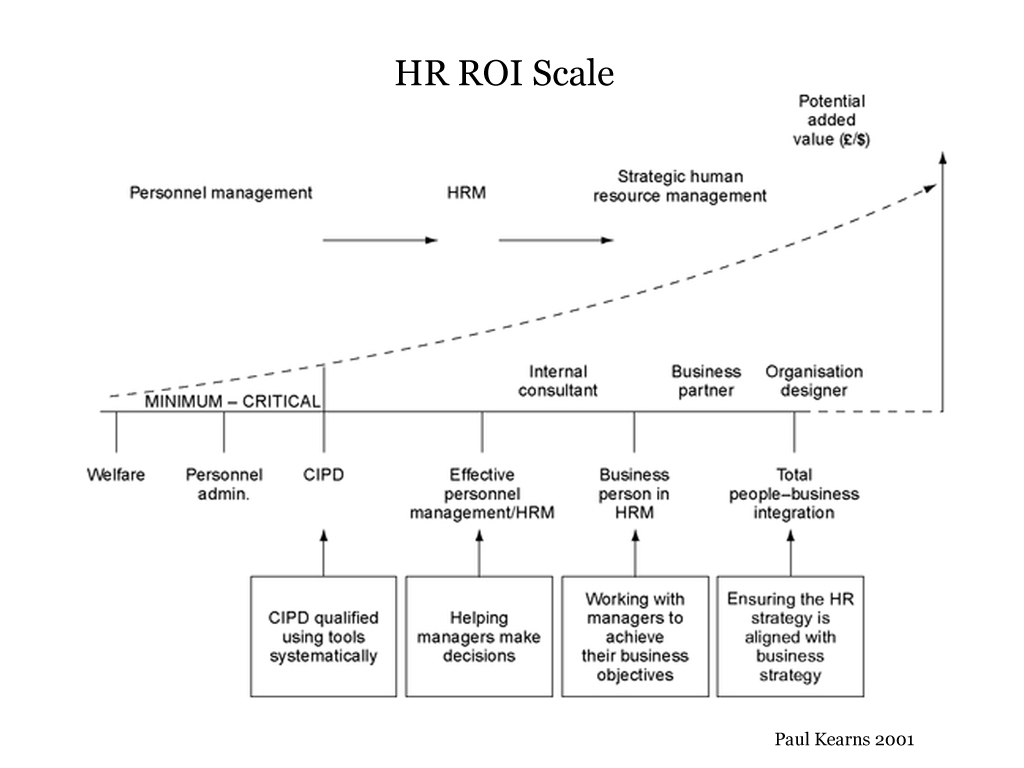
We are strategic business partners forcibly involved in the success of organizations evaluating not just hiring, firing and traditional hiring advisory roles but so much more. This is where the HR ROI Scale developed by Paul Kearns comes into play.

Job titles, responsibilities, business involvement and other factors make HR an interesting and challenging career to work and play. A lonely yet noble profession, it’s not uncommon for HR professionals to have little to no friends of work social life due to the complexities the industry brings. Thursdays happy hour work drinking buddy could be the subject of Friday’s termination meeting, and HR doesn’t like being seen as favoriting employees or silly little things like feelings getting in the way of being the voice of reason at your company.


UNDERSTANDING JOB DESCRIPTIONS & RESPONSIBILITIES IN HR

As the HR ROI Scale above suggests, the more strategic the role, the more complex strategies and decision making becomes in your HR role at the company. While I’m not an advocate of using the term personnel management, it does sum up a great deal of what the lesser strategic but not less important roles might be.


HR Coordinator. A true administrative position. An HR coordinator has responsibility for filing, maintaining reports, processing payroll and typically the scheduling of interviews. HR Coordinator’s might plan and organize events, develop email content for newsletters and other inter-office communication within the department and the company. Their roles are focused on administration providing a valuable service to the organization in maintaining order and a system for everything. They are hourly non-exempt workers.


HR Specialist. Typically 1-3 years of experience working in HR. Still focused on administration, payroll processing and other administrative tasks. HR specialists can gain additional experience working on speciality projects, employee orientation, training, and pre-screen interviewing. Human Resource Specialists have a basic understanding of some employment law. They are hourly non-exempt workers and serve as a go-to resource for employees and managers alike.


HR Managers. Typically a salary level position these human resource managers may or may not oversee and supervise a staff of employees. Generalists in their roles these individuals often do a bit of “everything” including benefits, compensation, recruiting and handing employee relations issues each and every day. The responsibilities in this role are very wide everything from location forecasting and budgeting, recruiting and interviewing. HR Managers sometimes process payroll but are less administrative than coordinator or specialist roles. Often they are cross-trained in the administrative tasks for emergencies.


HR Directors. Often responsible for HR teams of 2 or more, human resource directors oversee a region, a number of locations or serve as the highest ranking member of HR within the company but this is not always the case. HR Directors often are responsible for building annual budgets and often times have decision making when it comes to buying software, systems and negotiating benefits offerings for the company. Less likely to be a department of 1 than the HR Manager, their responsibilities are less compliance and policy and more focused on building relationships with executive team members and driving results for the organization focused on human capital and company.


HR Business Partner. This role is seen less of a generalist or manager and someone who takes a more consultative role working in HR. Human resource business partners have clients within the organization they provide resources and build relationships with focusing on the missions and objectives set forth by the organization. There is much less focus on compliance and administration. An organization instead typically has a HR Services Center or central department to help provide support in the form of policy development and enforcement, benefits and compensation. This person is seen as an operational and more strategic resource for the region or area in which they support. This is an exempt level position.


VP of HR. Depending on the size of organization, the vice president of human resources often reports directly to the CEO or COO of an organization although sometimes the CHRO or chief human resource officer has this distinction. Depending on the structure and size of the organization, the VP of HR works with the executive team to discuss business objectives. They view financial documents and work to understand how the focused programs and services they offer the organization drive revenue.


The VP of HR works to integrate people into the full scope of business operations evaluating how the impact of human capital benefits the overall organization. This position is heavily focused on business metrics, reporting and analytics directly in contrast to the administrative roots of the industry. This is an exempt level position and often a key decision maker at the company.

What’s in a Name? Human Resource Business Partners v. Human Resource Generalists

Bright lines between Human Resource Business Partners, Human Resource Generalists, and Line 
Managers

I also believe HR needs more diverse career paths instead of ladders, but more about that later. If you want to be a strategic HRBP, then it’s an MBA. I have literally put my money where my mouth is on that recommendation, having pursued an MBA instead of an MS HR because I wanted to provide broader strategic value to the business. On the other hand, if you want to be a senior HRG or enter an HR Center of Excellence localized areas of in-depth HR expertise then I would recommend an MS in 


HR.

Why do I see such a strong distinction? Let’s face it: HR isn’t at the table with senior leaders in the manner or frequency we would like to be. This is in part because of the bias against HR, but in a much larger part because of HR’s focus on human resources as a stand-alone function (rather than taking a systems thinking view) and lack of understanding of other areas of the organization (e.g., finance, IT, mission areas). If we, as HR professionals, want to be at the table, the change starts with our capabilities, not with the attitudes of senior executives toward HR. We need to show our value in the language of business executives.


For shared understanding, let’s clarify the definition of HRBPs and HRGs for this blog. The Human Resource Business Partners (HRBPs) perform a strategic role by advising leadership on how human capital management can support larger goals and initiatives. In other words, HRBPs have a deep understanding of – and role in – determining how to achieve its mission. HRBPs also understand the fundamentals of other components of the organization, how they add value, and how they interact with HR. HRBPs view HR through a systems thinking lens. 

Human Resource Generalists (HRGs) are primarily responsible for the traditional work of the HR department, like HR policy and administration, employee relations, recruitment and change management. The depth of those skills can vary depending on the size and needs of each agency, but generalists must be well-versed in all things HR and bring a breadth of knowledge and skills. Centers of Excellence provide a depth in one area of HR. For example, according to a SHRM survey, 

Training is the HR specialty most often delivered by a center of excellence.  Also for the sake of simplicity, when I say “business” in this article, I am referring to the mission-facing parts of your Federal organization as distinct from HR.

In many organizations, all HR Generalists consider themselves business partners. Being a business partner is cool now, right? Like floral prints for spring 2014 or “Selfie” now that it’s in the dictionary. And everyone wants to be “strategic.” 

The mismatch of expectations to what’s delivered negatively affects HR as a whole. At the root of this problem is the false assertion that strategic roles add more value than tactical roles and therefore that HRBPs add more value than HRGs. In general, HRBPs are higher in the organization and have more power and resources to wield, so one could (incorrectly) view that as adding more value. That does not, however, mean they create a higher ROI as human capital. To the contrary, the highest ROI from your HR organizations comes from delineating HRBPs from HRGs and COEs to maximize specialized value added by each group.


Furthermore, the rise of Human Resources Lines of Business (HRLOB) and Shared Service 

Centers (SCC) has transferred administrative work away from HRGs and shifted their focus to delivering critical tactical services. Tactical is valuable! Delivering tactical HR services in an efficient, effective manner that reduces risk to the organization and contributes to optimizing human capital is priceless.

From the view of many HR professionals, becoming an HRBP is a natural progression from an HRG role, requiring experience without any transformational change in skills and aptitudes (i.e., building on existing skill sets).  I would argue, however, that this assumption is part of the problem HRBPs face in gaining credibility as business experts. 

Instead of having an HR Career Ladder allowing for mostly vertical movement (preferably upwards, of course), organizations would benefit from a clear delineation between HR roles that creates a career path with lateral moves for upward mobility. For example, from a junior HRG role, I could aspire to a senior HRG role as a people manager, an HRBP role, or a role in a Center of Excellence. 

The required skills and experience should be differentiated and align with the roles. 


Following the example I referenced earlier, I recommend an MS in general HR for the Senior HRG role, and MBA for the HRBP, and a specialized MS HR for the COE role. That is not to say the position should require such qualifications. 

One of the best HRBPs with whom I’ve ever worked was a lawyer (I guess Shakespeare was wrong about them.) The only universal recommendation I would make is to have a career path with supporting plan (e.g., your IDP) and an HR Certification, which you should keep current though training and other professional development.

As HR practitioners, we are always eager to move into more strategic roles, but it is imperative that we not lose sight of the value and career opportunities in traditional tactical roles. 

I’ve met candidates who call themselves HRBPs but in fact are HR generalists and trouble-shooters. There are HRBPs who report to the CEO or Divisional head but where the relationship is anything but a partnership one and more like a subservient one. 


The truly commercial HR business partner has earned the respect and status they have but their influence on the business may not be obvious from their position in the organisation. Instead, I look beyond this to the way they have conducted themselves.


Let’s start by exploring how HRBPs choose to spend their time.

The biggest choice I have observed the commercial candidate make in their career is over what work they get involved in. Are they an HR generalist, a jack-of-all-trades who can turn their hand to anything from handling disciplinary cases to facilitating team meetings? Or are they a business leader who focuses on how to create the conditions for high performance or on how to build the workforce of the future?

I’m deliberately describing this as a choice because those who try to do both, invariably have less impact on the business. The more time they spend doing the jack-of-all-trades work, the less time they have to add real commercial value.


Making this choice isn’t easy. There is a prevalent myth to contend with here – that HR needs to get the basics right before they earn the right to do the strategic stuff. This has more than a grain of truth in it – if the basic security and welfare needs of employees are not being met, then the organisation is failing in it’s duty of care and will ultimately lose the loyalty of its workforce. If these basics are missing, nothing could be more commercial, or strategic, than putting them in place.


But this doesn’t mean that the HRBP has to meet these needs personally. They do, however, need to ensure that the processes, services, systems and behaviours are in place to deal with these issues. The myth is thinking that, once these are in place, they have to “keep their hand in” and provide some of these services themselves to their senior colleagues.


how did this improve the revenue or profit margin of the company or reduce risk?
what commercially valuable behaviours resulted from this intervention and why was it the best way of achieving this?

what other options were available to you and why did you reject them?

what outcome where you trying to achieve and how did this directly relate to the business strategy?
how did you measure the impact and what was the level of improvement over time?

what was the relevance of using best practice or applying external benchmarks in this company and how did these drive the achievement of the business strategy?


Clearly, these two factors are interconnected. The more time spent on strategic issues, the more opportunity there is for having a commercial impact. The more time spent on service delivery, when there are other ways these needs could be met for less cost, the more missed opportunities there are for commercial impact. 

What differentiates the truly commercial HRBP is not whether they can demonstrate commercial impact – it is how they free themselves up to deliver more and more commercial impact.

Tuesday, 25 November 2014

What is a Channel Partner, System Integrator, Value Added Reseller, Alliance Partner, Distributor, OEM ?

What is a Channel Partner, System Integrator, Value Added Reseller, Alliance Partner, Distributor, OEM ?

Channel partner

A channel partner is a person or organization that provides services or sells products on behalf of a software or hardware vendor. Value-added resellers (VARs), managed service providers (MSPs), consultants, systems integrators (SIs), original equipment manufacturers (OEMs) and distributors may all be called channel partners. Many companies, including CA, Microsoft, AMD, IBM, SAP and Oracle, have formed channel partnership programs to work more closely with the distributors for their products.

Channel partnerships provide an opportunity for companies to promote certain products or services. In return, channel partners receive access to product and marketing training, discounts, technical support, lead generation tools and beta versions of releases. A VAR that chooses to partner with a

Monday, 25 August 2014

How to find your published articles on linkedIn ?

How to find your published articles on linkedIn.
Your article is active to be viewed by you for 24 hours under who viewed your updates section in LinkedIn, but in case if you want to refer them after 24 hrs. Or you

How to publish your blog or want that someone who reads your blog can share your article on their linkedin ?

Hi All, if you want to publish your blog or you want that someone who reads your blog can share your article on their linkedin then follow these steps:

Add the InShare plugin to your website to enable members to share your content on LinkedIn.

You can get the code after entering your blog’s url like for example

Friday, 22 August 2014

Few Good Medical Insurance Policies in India

Few Good Medical Insurance Policies in India

Before glancing at the list of few good medical insurance policies, it is suggested that you understand what health insurance means. A type of insurance that covers medical and surgical expenses those are incurred by the insured. Health insurance either reimburses the insured for costs incurred from illness or injury or pays the care provider directly.

Mentioned below is the list of few Good medical insurance policies provided by the leading Indian Health insurers:

Star Health & Allied Insurance Company Limited

Star Family Health Optima Insurance Plan (Family Floater) (2 adults+2 children)

What is Mediclaim ? What is health insurance ? Mediclaim vs Health Insurance

How is a health insurance plan different from mediclaim policy?

Lot of individuals subscribe to mediclaim policies in the belief that they have adequate health insurance to address all health issues. This is not only inaccurate but might just prove a very costly oversight.

To be sure, mediclaim although a form of health insurance is far from adequate to cover the many illnesses and health conditions that have become so common given the stress and mishaps in everyday life.

Mediclaim

First let’s understand what mediclaim brings to the table.